What is the meaning of Pop Art
Pop art is an art movement that emerged in the 1950s and flourished in the 1960s in America and Britain, drawing inspiration from sources in popular and commercial culture. Different cultures and countries contributed to the movement during the 1960s and 70s. Pop Art's core characteristics include its use of imagery from popular, mass culture (like advertising, comic books, and mundane objects), bold, bright colours, a blurring of the lines between "high" art and everyday life, and often a tone of irony, wit, or commercialism. Key techniques include repetition, the use of everyday objects and celebrity culture, and incorporating commercial art methods such as screen-printing.
In 2025, Pop Art is an evolving style that uses familiar mass-media imagery, but now often incorporates personal, intimate, and culturally relevant narratives, memes, and digital elements alongside traditional commercial icons. It thrives across digital media, print, and traditional formats, leveraging the chaos of internet culture to create layered, accessible, and collectible art that reflects contemporary society's online experiences and personal stories.
Artwork Styles used in creating Pop Art include, Diptych (art) – A diptych is a work of art, traditionally a painting or carving, created from two separate panels that are intended to be viewed together as a single, cohesive piece. The two panels are linked by a shared theme, narrative, composition, or style, creating a dynamic visual experience that encourages the viewer to move between the two parts to understand the complete message.
Polyptych (art) – Polyptych art is a work, usually a painting, divided into four or more panels that can be connected or hinged to create a larger, unified composition. the term is part of a system where two-panel works are called diptychs and three-panel works are triptychs. Historically, polyptychs were often altarpieces, but the format is now used for various subjects and media. Gradation (art) – Gradation in art is the principle of gradual transition from one element to another, such as colour, shade, size, shape, or texture, to create a smooth and harmonious effect. This technique is used to add visual continuity, depth, and three-dimensional properties to an artwork, helping to define form, create a sense of atmosphere, and guide the viewer's eye through the piece
Pop Artworks
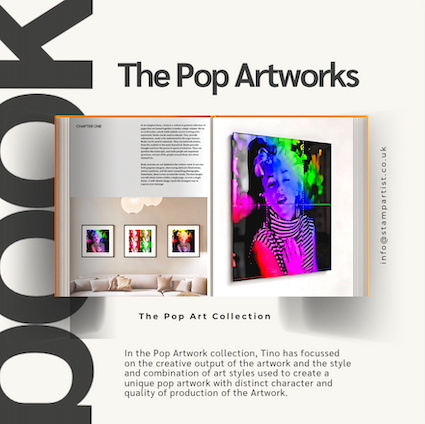
In the Pop Artwork collection, Tino has focussed on the creative output of the artwork and the style and combination of art styles used to create a unique pop artwork with distinct character and quality of production of the Artwork.
The artworks draw inspiration from the Laos 2000 Marilyn Monroe cinema souvenir sheet. This sheet was never officially issued for postage; instead, it belongs to a category of unissued thematic stamps (often called "Cinderellas") collected worldwide solely for their artistic value. From a legal standpoint, the design utilizes images published prior to January 1, 1964, which have entered the public domain. Furthermore, Monroe’s likeness is not protected by posthumous publicity rights in key jurisdictions. While the intersection of intellectual property rights remains complex—as separate protections apply to specific photographs versus her name—the images themselves are free from copyright restrictions, allowing these decorative sheets to be openly traded on global online marketplaces.
Public domain images
-
Copyright expiration: Many photographs and creative works featuring Marilyn Monroe that were published in the United States before January 1, 1964, have entered the public domain. This happened because their copyrights were either not renewed or proper copyright notices were not applied.
-
Commercial use allowed: Once in the public domain, these images can be used and modified for personal and commercial projects without needing a license from the original creator or copyright holder. This makes it possible for anyone to produce and sell stamps and other merchandise featuring those images.
The Pop Artworks by Tino highlight the irony of an ever-evolving postal service around the globe and the difficulties faced by these services in policing mass reproduction and sales of these postage stamp reproductions over the internet as the internet continues to grow exponentially.
“The questions I am raising in these Artworks are. Is this Irony, a shift of acceptance by the postal service who have now entered the financial sector as a face for retail banking, an acceptance that the evolution of the digital age, will move all monetary services, as we know them, to become a monochrome, barcoded system in the future”. Tino.
Recognised postal issues by the Royal Mail and USPS postage stamps available for sale can be printed for education, critique and personal review but not for mass reproduction. Unrecognised postage stamps and thematic postage stamps involving copyrighted images are available for sale are also subject to the same conditions.
Each Pop Artwork is created using a fresh Mint postage stamp for each Artwork print and includes a Mint postage stamp with the artwork, with the Artwork produced to the highest of fine art standards and singed by the artist making each Pop Artwork, a unique hand crafted piece of artwork for enthusiasts and collectors to admire.
Other Artistic Representations Pop Art involving Marilyn Monroe
Famous artists who have used Marilyn Monroe's image include Andy Warhol, known for his pop art screen prints like the Marilyn Diptych and the Marilyn Monroe Portfolio. Other artists who have depicted Monroe include Willem de Kooning, Marlene Dumas, Richard Hamilton, and Pauline Boty.
Andy Warhol:
-
Technique: Warhol used a silkscreen technique to create his iconic, colourful portraits.
-
Timing: He began creating his Marilyn Monroe works shortly after her death in 1962.
-
Key Works: The Marilyn Diptych (1962) and the Marilyn Monroe Complete Portfolio (1967) are some of his most famous pieces.
-
Themes: Warhol's work explores themes of fame, mass culture, beauty, and tragedy.
Willem de Kooning:
This abstract expressionist artist also painted Marilyn Monroe, though his style is distinct from Warhol's.
Marlene Dumas:
Dumas, a contemporary artist, also created pieces inspired by Monroe's image.
Pauline Boty:
As a prominent figure of the British Pop Art movement, Boty depicted Monroe in her artwork.
Richard Hamilton:
Another key figure in Pop Art, Hamilton also used the image of Marilyn Monroe in his works.
Other artists who have captured Marilyn Monroe include: Sir Peter Blake, Rosalyn Dexler, Mike Edwards, and Michael Ochs